Words for the Aftermath.
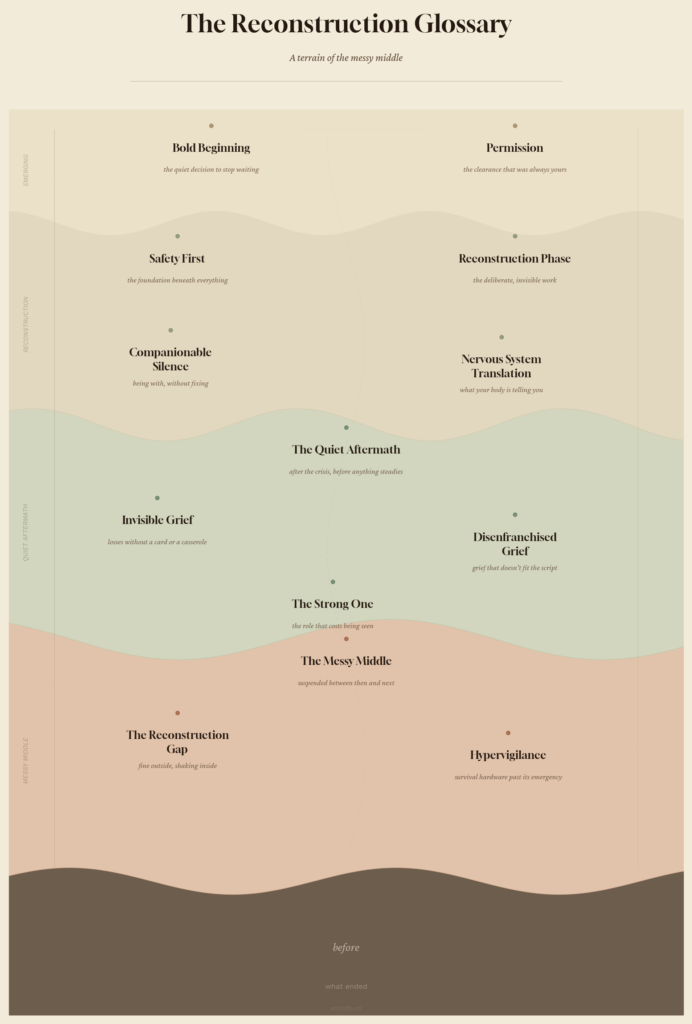
After the crisis is over, it can sometimes feel like our words run out. We find it difficult to explain (to ourselves and to others) what we are experiencing. Working with women in the aftermath of crisis, I know that words have power. And, that having the right words can help us understand and navigate the aftermath a little easier. Just one word, if it is the right word, can ease the discomfort and make you feel less alone. This glossary is for you, use it, share it and make it your own.
The Messy Middle
That limbo space we find ourselves in after one thing has ended, and the new has not yet arrived. The messy middle can feel disorienting, aimless, chaotic or foggy. You might notice you are in a messy middle if your emotions no longer feel reliable. You might lie awake in the night with thoughts that won’t stop circling. You feel stuck, or stalled somewhere between an old life and a new one, and neither feels like home. The messy middle is not a wrong turn or a detour. It is a place on the way to what comes next. It is the place where the real rebuilding happens, even when it doesn’t feel like it.
The Aftermath
The time that comes after the crisis has passed. When the emergency is over, but the impact is still moving through you. When everyone else assumes you are fine. But you still do not feel steady or fine. This is a phase no one talks about, and it’s exactly where reconstruction begins.
Reconstruction Phase
The season of quietly recalibrating, untangling and finding your feet again. The reconstruction phase comes after the crisis. It comes when you are ready for the deliberate, often invisible work of rebuilding identity, trust, and stability. Reconstruction doesn’t look dramatic from the outside. It looks like someone making small, steady decisions from a calmer place.
The Strong One
The woman everyone leaned on during the crisis. The one who held it together, organised the practical things, while saying “I’m fine”. Being the strong one is a role that we often take on during a crisis. We want to get through, and make sure everyone around us are ok. If you’ve always been the strong one, it can now feel impossible to ask for help. You may not even know how.
Invisible Grief
The losses that don’t get a card or a casserole. The death of an ex-partner. A friendship that quietly ended. A miscarriage no one knew about. The loss of an identity you spent years building. A family estrangement that everyone avoids mentioning. Invisible grief is real grief, it just doesn’t come with permission to feel it.
Disenfranchised Grief
Grief that isn’t socially recognised or validated. You’re grieving, but the loss doesn’t fit the script of everyone else, so you learned to carry it quietly. You might be grieving a living person, a life you chose to leave, a version of yourself that no longer exists, or a future that will never happen. Disenfranchised grief often comes with a particular kind of loneliness: the feeling that your pain doesn’t count.
Nervous System Translation
Understanding what your body is telling you when your mind can’t make sense of it. You’re exhausted but can’t sleep. You snap at people you love and don’t know why. Your shoulders have been up around your ears for weeks. You feel on full alert in your kitchen, even on a quiet Sunday afternoon. This is not a character flaw. This is your nervous system doing exactly what it was designed to do, to protect you from something that already happened. Translating these signals doesn’t fix everything, but understanding what is happening and why is a huge step forward in reconstruction.
Hypervigilance
The feeling of being permanently on alert, even then the room is quiet and nothing is wrong. You read the same message twice, you read the tone of it three times. You brace for news that doesn’t come, rehearsing replies in your mind. You cannot settle, even in places that used to feel safe. After a crisis, hypervigilance is your nervous deciding it cannot ever be caught off guard again. It was caught off guard last time when the crisis hit without warning. So now it watches for the next crisis. It’s not anxiety. It’s not overthinking. It’s your survival hardware running in a situation that no longer requires it.
The Reconstruction Gap
The distance between how you look on the outside and how you feel on the inside. You’re functioning. You’re showing up. People tell you how well you’re doing. But underneath, you’re shaky, uncertain, and exhausted from performing steadiness you don’t feel. The reconstruction gap happens when everyone around you assumes you are fine and no one is actually seeing what you are going through. This is why women in the aftermath often feel so alone.
Safety First
The foundation of all reconstruction work. Before rebuilding, before decisions can be made, before anything meaningful can shift, your nervous system needs to feel safe enough. Not perfectly safe. Not “everything is fine” safe. Just safe enough to stop bracing. This is where my work begins. Always.
Companionable Silence
Sitting with someone in pain, without needing to fix, teach, or fill the space. Not every moment of pain needs a response. Sometimes the most powerful thing another person can offer is their quiet presence, without an agenda, without advice, without rushing you toward an ending. Companionable silence is a key part of how I coach. It’s also how I write. Not leading the way, just walking alongside.
Bold Beginning
Not a dramatic reinvention. Not a “new year, new me” moment. A bold beginning is the quiet decision to stop waiting for permission to start building a chapter that feels like yours. It often looks unremarkable from the outside. But can hold a lot of power, like a boundary held, a clarity call booked, a morning protected for writing, a “no” that didn’t come with an apology. Bold beginnings rarely announce themselves. They accumulate.
Waiting for Permission
The quiet, often unconscious act of waiting for someone else to tell you its okay. Waiting for the sign that you can feel what you are feeling. Waiting for permission to start something new without apologising for it. If you have spent years managing other people’s comfort, you may have lost access to some of your own authority. You know what you need, but you wait for permission from some external source. The shift happens when you realise the permission you have been waiting for was always yours to give.
These words are yours now. Use them. Say them out loud. Share them with a friend who might need the language too.
And if reading this named something you’ve been carrying:
→ Read Letters for the Brave — where I write about these things weekly
→ Start Here — if you’re looking for support, tools, or a quiet place to begin